
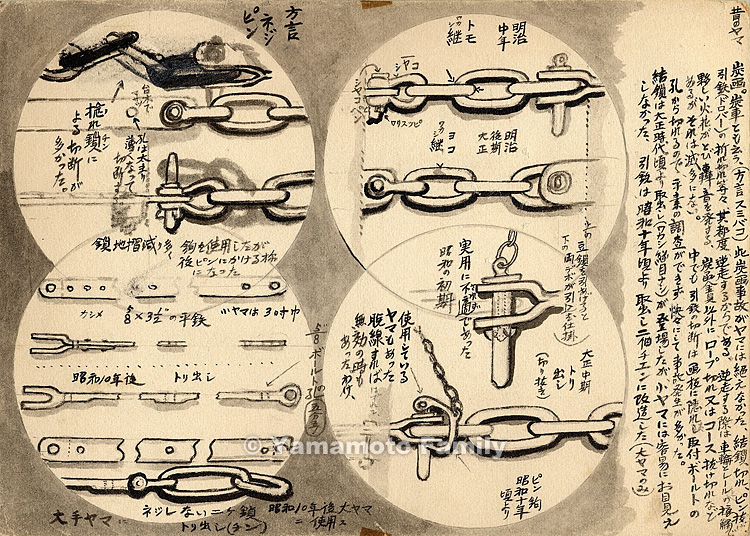
Coal Pits (Yama) in the Old Days (Couplings of Mine Cars)
1958 - 1963
Mukashi no Yama (Sumibako no Tsugi)
[Coal Pits (Yama) in the Old Days (Couplings of Mine Cars)]
21.2 x 30.4 cm Ink Painting
The mine car or tub usually called a sumibako (in pit dialect) was also called a tansha. Mine car accidents regularly occurred in the coal pit. Every time coupling chains were cut, connecting pins came off, drawbars broke, etc., mine cars could cause accidents when they reversed.
In these cases, the friction between the mine car wheels and rails caused innumerable sparks and great noises. Such accidents were also rarely caused by the cutting of wire ropes or the dropping out or breakage of wire rope sockets.
Among these causes, drawbar breakage on mine cars often occurred and caused accidents. It was because drawbars broke from their bolt holes, which were hidden by the bottoms of mine cars, and it was difficult for miners to usually check them.
Chains composed of links with no welds (toridashi: cutout) became available around the Taisho era (1912-1926), but they were not easily introduced to small-scale coal pits. Only the drawbars used in large-scale coal pits were improved and changed to cutouts with two-link chains on both of their ends around 1935.
Figures in the Inset at the Top Right
Upper Figure
Meiji Chunen Tomo Wakashi-tsugi: metal fittings for coupling mine cars in the mid-Meiji era (1868-1912) including chain links, each with a weld at one of the narrower ends
Parts Names
shako: shackle
shako-pen: shackle pin
warisuppi: split pin
Lower Figure
Meiji Koki Taisho Yoko Wakashitsugi: mine-car coupling chain composed of links, each with a weld at one of the wider ends in the mid-Meiji and Taisho (1912-1926) eras
Figures in the Inset at the Bottom Right
Upper Figure
When the little chain on the top was pulled up, the two latches below withdrew.
This device was introduced in the early Showa era (1826-1989), but was not actually used because of its inconvenience.
Lower Figure
Taisho Chuki Toridashi (Kirinuki): chain composed of links with no weld (cutout) in the mid-Taisho era (1912-1926)
Pinkagi Showa Junen Koro Yori: pin hook to prevent the pin to coming off, which appeared around 1935; It was used in some pits, but was sometimes not useful when derailments occurred because it often broke off.
Figures in the Inset at the Top Left
Upper Figure
This condition of the coupling chain was called neji pin in pit dialect.
Twists of coupling chains (nejire chin or neji pin) for mine cars often caused their breakage.
Screw holes in the drawbar were widened and the drawbar was thinned down with the friction between the wooden bottom of the mine car and itself, and the bar finally broke.
Lower Figure
Since the chain link connected to the drawbar easily wore out, a hook was used between the link and the shackle for a while, but later the chain was directly hitched around the connecting pin.
Figures in the Inset at the Bottom Left
Top and the 2nd Figures
This drawbar was made of 5/8" x 3 and 1/2" flat steel and the lower part of its shackle was attached by caulking. The one used in small coal pits was made of 3-inch-wide flat steel.
The 3rd and the 4th Figures
This drawbar is a cutout from flat steel, which has holes for 5/8" bolts and has been used since 1935.
Bottom Figure
This is a never-twisting chain with two cutout links with no weld, which has been used in large-scale coal pits since 1935.
Translation Assisted by Mr. Nathan Johndro
<<Last pictorial record Next pictorial record>>
<<Last 10 items 91 | 92 | 93 | 94 | 95 | 96 | 97 | 98 | 99 | 100| Next 10 Items>>
100/585