
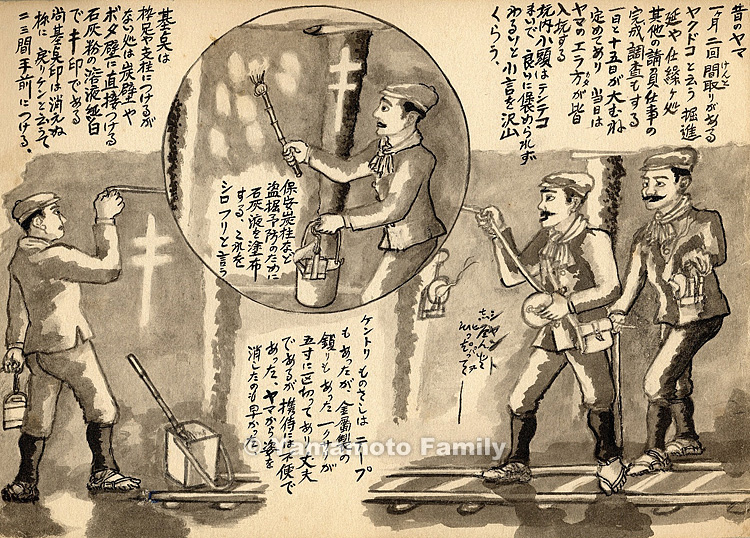
Coal Pits (Yama) in the Old Days (Underground Survey; Applying Limewater on Coal Pillars)
1958 - 1963
Mukashi no Yama (Kentori; Tanchu no Sekkaieki Nuri)
[Coal Pits (Yama) in the Old Days (Underground Survey; Applying Limewater on Coal Pillars)]
21.1 x 30.3 cm Ink Painting
Text at the Top Right
The underground survey called kentori was carried out twice a month in every coal pit. When the survey was carried out, the results of contract work at important headings called yakudokos and repaired points and so on were also inspected. The survey was generally made on the 1st and 15th day of every month and all executives in each pit (yama) entered the pit on these days. Underground bosses were very busy on these days, and they were not praised even if the results were good but when the results were bad they were rebuked very harshly.
Text at the Top Left
The mark of "ki" in katakana (resembling a cross with two bars) showing "kiten (benchmark)" was painted in white limewater. The benchmark was usually made on a frame leg or a pillar, but if there were no frames or pillars nearby, it was made directly on a wall of coal or rock. Actually, the benchmark was made at a point 2 or 3 ken (approx. 3.6 or 5.5 meters) short of the real point, which was called a modoriken, in order to prevent it from vanishing.
Text below the Inset
The metal chain measure was also used in kentori as well as the tape measure. A single chain link of the chain measure was as long as 5 sun (16.5 centimeters), and the measure was sturdy but not inconvenient to carry. The measure soon disappeared from the coal pit.
Words Uttered by the Underground Boss in the Center
[Translator's Notes: Words uttered by the underground boss in the center are written in three kinds of phonograms, all of which originated from Chinese characters and represent Japanese syllabary, such as katakana and hiragana as well as hentaigana.]
"Shan to hippatte!"
"Pull it tight!"
Text in the Inset
Applying lime water to safety coal pillars to prevent them from being illegally cut was called shirofuri.
Translation Assisted by Mr. Nathan Johndro
<<Last pictorial record Next pictorial record>>
<<Last 10 items 121 | 122 | 123 | 124 | 125 | 126|127 | 128 | 129 | 130 | Next 10 Items>>
126/585