
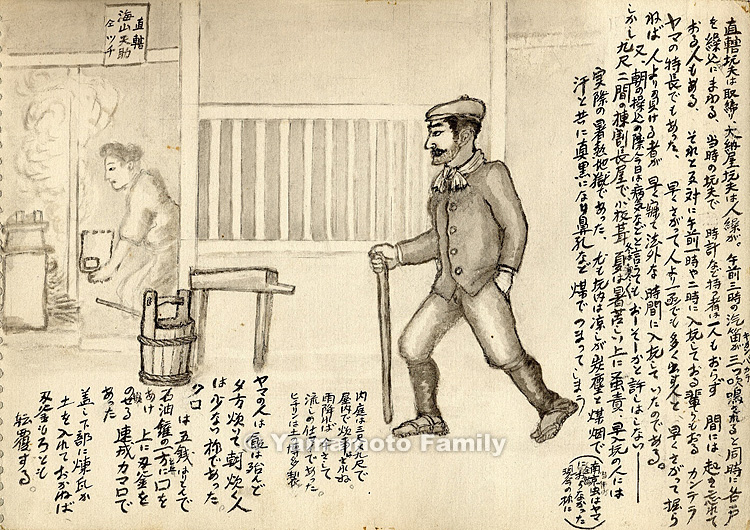
Regulators, Personnel Supervisors, and Cooking Stoves
1958 - 1963
Torishimari, Hitoguri, Suihan no Kudo
[Regulators, Personnel Supervisors, and Cooking Stoves]
20.9 x 29.9 cm Ink Painting
Text at the Right End
Regulators (torishimari) and personnel supervisors (hitoguri) brought together miners called chokkatsu kofus under the direct control of the mine company and miners called o-naya kofus under the control of their miner-group bosses respectively. They made the rounds of miners' houses or unmarried workers' boardinghouses (o-naya) as soon as the three whistle blows from the boiler house (kikan-ba) announced that it was 3 a.m. No pit worker at that time had a clock or a watch and often some of them failed to get up. Others entered the pit at 1:00 or 2:00 a.m. This lack of punctuality was a characteristic of poor small pits called kantera yamas, which only used lamps underground. Miners who wanted to mine even a mine-car-load of coal more than others and/or miners who could not mine as much coal as others without entering the pit earlier would go to bed, get up, and enter the pit outrageously early times.
Then again, regulators and personnel supervisors would not allow someone saying that he was ill to take a day off when they made the rounds in the morning. Each of the pit workers' row houses was 9 shaku (about 2.7m) wide by 2 ken (about 3.6 m) long and its roof was shingled. Therefore, the inside of the house was so cold in winter and so hot and full of fleas in summer that those houses were really hellish for workers who entered the pit early. Though it was cool underground, miners' bodies were blackened with coal dust and soot adhering to them because of their sweat, and their nostrils were choked with the soot. (No bedbugs were seen in coal pits at that time as they are today.)
Text at the Bottom Left
The court of each row house was 3 shaku (about 90 cm) wide by 9 shaku (about 2.7 m) long and families could not cook inside their houses. They had to wash their dishes in the sink outside of their houses with an umbrella in hand when it rained. The shown clay portable cooking stove called a hichirin (normally shichirin) inside the house was made in Hakata [today's Fukuoka City].
It seemed that the people in coal pits cooked rice mostly in the evening and scarcely did it in the morning. The other cooking stove called a kuro (normally kudo) inside the house was a kamaro (normally kamado: furnace) and could be quickly made with an oil can sold at as much as 5 sen (0.05 yen) by cutting off its top and making an opening in the lower part of its one side. The rice cooking pot called a hagama with a brim around it was used on top of the kamaro. However, the stove would upset together with the pot if it was not stabilized with bricks or some earth put on the inside of its bottom.
Lettering on the Doorplate
chokkatsu: Direct Workers
Umiyama [family name] Tensuke [given name (for a man)]
[Translator's Notes: This name is an imaginary one, in which "umi," "yama," and "ten" stand for "sea," "mountain," and "heaven" respectively.]
Doh [the same family name: wife] Tsuchi [given name (for a woman)]
Translation Assisted by Mr. Nathan Johndro
<<Last pictorial record Next pictorial record>>
<<Last 10 items 131 | 132 | 133|134 | 135 | 136 | 137 | 138 | 139 | 140 | Next 10 Items>>
133/585