
Children in Coal Pits #3 (Boys' Games)
1958 - 1963
Yama no Kodomotachi #3 (Otokonoko no Asobi)
[Children in Coal Pits #3 (Boys' Games)]
21.2 x 30.1 cm Ink Painting
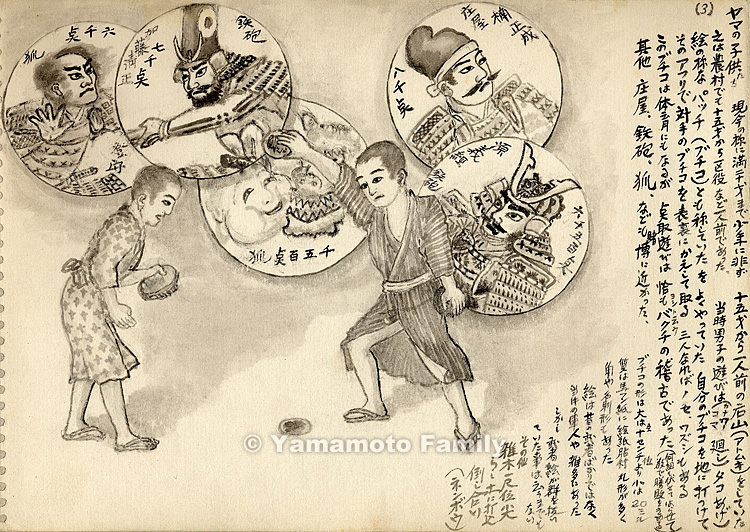
Boys in coal pits in the old days were regarded as adults earlier than today's boys who are regarded as adults after they become 20 years old. Every boy worked as a full-fledged helper called an atoyama (atomuki) of the coal hewer (sakiyama) after he became 15 years old. Boys in farm villages also worked as full-fledged laborers after they became 15 years old. Boys at that time mainly enjoyed top spinning (with tops with an iron ring), kite flying, and patchi (buchiko: pog) as shown in this picture. In patchi, a player flung one of his buchiko cards on the ground to turn over the opponent's one by causing a slight wind and take it. When three boys played with the patchi cards, they also played games called nose and wazushi. These buchiko games were also useful for physical training. However, the score-keeping game with these cards was just like the training in a gambling game called yoshi, in which some combinations of hanafuda cards were laid on their faces to let gamblers bet on them and the outcome was decided by the scores shown by the cards. Other buchiko games called shoya, teppo, and kitsune also resembled gambling games.
Most buchiko cards were round pieces of cardboard about 10 cm at maximum and about 20 mm at minimum in diameter. A piece of paper with a picture printed on it was pasted on each of them. Some of these cards were square shaped like business cards. Not only pictures of ancient warriors but also pictures of the military at that time were printed on the pieces of paper pasted on these cards. It goes without saying that the pictures of warriors were the largest in number among them. Boys also played another game called nembo in which each boy sharpened one end of a 1 shaku-long (about 30-cm long) stick and stuck it into the ground before trying to knock his opponent's stick down.
Lettering on the Shown Patchi Cards (Right to Left)
Minamoto Yoshitsune: Yoshitsune Minamoto
[Translator's Notes: He is one of the most popular samurai commanders and was tragically killed in 1189, after he destroyed the Taira Clan, by his elder brother Yoritomo Minamoto, the founder of the Kamakura Shogunate.]
teppo: gun
rokusen gohyakuten: 6,500 points
Kusunoki Masashige: Masashige Kusunoki
[Translator's Notes: He was one of the commanders during the period of the Northern and Southern Courts (1336-1428), who is famous for his loyalty to the latter court.]
shoya: village headman; squire
hassenten: 8,000 points
kitsune: fox
sen gohyakuten: 1,500 points
Kato Kiyomasa: Kiyomasa Kato
[Translator's Notes: He was one of the strongest feudatories of Hideyoshi Toyotomi who reigned over Japan from 1585 until 1598 as the chief advisor to the emperor, and later served Ieyasu Tokugawa, the founder of the Tokugawa Shogunate, after Hideyoshi died.]
teppo: gun
nanasenten: 7,000 points
Noto-no-kami : Lord of Noto Province [Tsunemori Taira]
[Translator's Notes: He was the strongest among the commanders of the forces of the Taira Clan, which fought against the forces of the Minamoto Clan. He fought bravely and defeated the enemy several times but finally drowned himself in the sea of Dannoura where his family fell in 1185.]
kitsune: fox
rokusenten: 6,000 points
Translation Assisted by Mr. Nathan Johndro
<<Last pictorial record Next pictorial record>>
<<Last 10 items 141 | 142|143 | 144 | 145 | 146 | 147 | 148 | 149 | 150 | Next 10 Items>>
142/585