
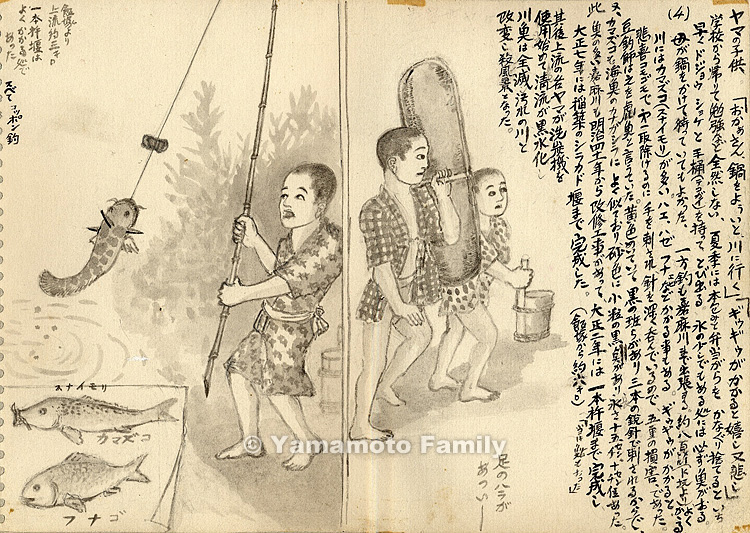
Children in Coal Pits (Yama) #4 (Scooping Loaches and Fishing)
1958 - 1963
Yama no Kodomo #4 (Dojo-tori to Sakanatsuri)
[Children in Coal Pits (Yama) #4 (Scooping Loaches and Fishing)]
21.0 x 30.0 cm Ink Painting
Senryus (short witty and humorous seventeen-syllabled poems)
"'Okaasan, nabe o yoi!' to kawa e yuku."
"I went fishing in the river, saying, 'Mother, prepare a cooking pot and wait for me.'"
"Gyugyu ga kakaru to ureshi mata kanashi."
"I feel happy and sad at once after hooking a gyugyu (a cut-tailed bullhead)."
I did not study at all after I came home from school. In summer, I raced out for fishing, holding a dojo shoke (a shallow bamboo basket for scooping loaches) and a tekogai (a wooden bucket) after throwing off my books and empty lunch box as soon as I came home. Where there was some water there were fish without fail. I never disappointed my mother waiting to cook my fish in her cooking pot.
In the meantime, I went fishing all the way to the Kama River about 800 meters away from K Coal Pit, where I could hook a lot of fish. This river was rich in kamazuko (a dialectal name of ikanago or the Japanese sand lance: sunaimori). I sometimes hooked minnows, crucian carps, and shrimps. Every time I hooked a gyugyu, I felt a mixed feeling of happiness and sadness. It was because I pricked my fingers with its needles when I managed to remove my hook which it had deeply swallowed. Therefore, hooking a gyugyu caused five-fold damage in return to me. We children at that time as little fishermen called this fish tora uo (tiger fish). It was because it had black spots on its yellowish body and we always pricked our fingers with its three sharp needles. Additionally, the kamazuko looked like the kanagashira of sea-fish, having small spots on its sandy body of 15 or 16 cm long.
The improvement work of the banks of the Kama River which was abundant in fish began in 1908. The construction from the separation of the river to Ippongi Dam was completed in 1913 and to Shirakado Dam in Inatsuki (about 6 km away from Iizuka) in 1918. There were also sweetfish (ayu) in this river at that time. After that, each coal pit by the upper Kama River started using coal washers and the clear water of this river turned black and dirty. All of the fish were killed and the Kama valley became desolate.
Text at the Top Right
I could hook a lot of fish at Ippongi Dam which was about 3 km up from Iizuka. I fished all of them with rod and line (kopponzuri) .
Text at the Bottom Center
The ground was so hot that the soles of our bare feet were almost scalded.
Letterings in the Inset at the Bottom Left
sunaimori; kamazuko: Japanese sand lance
funago (funa): crucian carp
Translation Assisted by Mr. Nathan Johndro
<<Last pictorial record Next pictorial record>>
<<Last 10 items 151 | 152 | 153 | 154 | 155 | 156|157 | 158 | 159 | 160 | Next 10 Items>>
156/585