
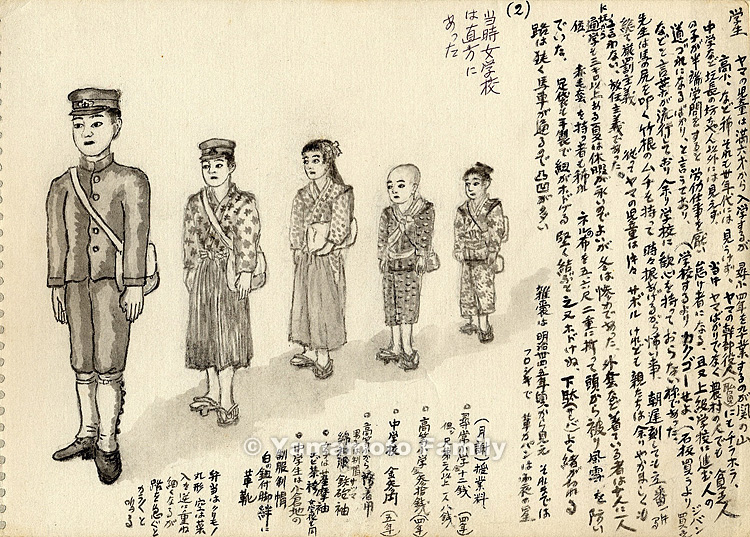
School Children #2
1958 - 1963
Gakusei #2
[School Children #2]
21.0 x 29.9 cm Ink Painting
Children in the pit (yama) entered the ordinary primary school (jinjo shogakko) at the age of 6, and they could finish the four-year school at best. They rarely went to the higher primary school (koto shogakko). None of them went to the higher primary school during the fourth decade (1897-1907) of the Meiji period (1868-1912) except a few children of executive officers (staff) of the pit. No child except the son of the pit foreman could go to the junior high school. Not only the people in coal pits but also the people in farm villages did not have much interest in schooling. Those people said that if children of poor people like themselves left their studies unfinished, they would be so lazy that they would hate manual labor and would want to go to higher schools as children of executive officers did. There was a popular saying that went like this: Gakko suru yori kakugo seyo. Sekiban kau yori jiban kae. (Children should prepare to work instead of going to schools. They should buy underclothes instead of buying lithographs.)
Children were very afraid of the schoolteachers because they sometimes threatened children with rods made of bamboo roots, which were originally used for whipping horses on the rump. Children who came late for school had to stand in the hallways outside their classrooms for an hour. Children who violated the rules of each school were always severely punished. Therefore, parents in the coal pit let their children do as they please without being strict with them though they sometimes were truant.
We had to walk from K Coal Pit to our primary school for more than three kilometers. We were happy in summer because we had a long vacation every year, but were miserable in winter. Only one child out of ten had a coat and few children had a red blanket to wrap themselves on their way to and from school. Each of the children double folded a piece of flannel cloth 5 or 6 shaku (about 150 or 180 cm) long and covered their head and body with it to protect themselves from the wind and snow. Our Japanese socks called tabis were also handmade and their strings easily untied. However, they were hard to untie if we tied them tight. Straps of clogs (having replaceable teeth, sashibas) often broke. The narrow road to the school was always rough because carts and wagons were used there.
School children began to use cotton shoulder bags around 1901 or 1902. They had used wrapping cloths until then. Leather bags were seen as rarely as stars on a rainy night.
Text at the Bottom
Monthly Tuition (gessha: jugyoryo)
Ordinary Primary School: 12 sen (0.12 yen) (4 years); 8 sen per one child, provided more than one sibling went to school at the same time
Higher Primary School: 30 sen (4 years)
Junior High School: 3 yen (5 years)
The higher-primary-school children wore Japanese skirts (hakama). The higher-primary-school boys also wore school caps and cotton Japanese jackets with straight arms called Satsuma sodes.
School girls wore Japanese jackets with Satsuma sodes and maroon Japanese skirts. The girls' school children wore the same jackets and skirts.
The junior-high-school boys wore school uniforms and caps of Kokura fabric and also wore gaiters with white strings and leather shoes.
Each of the school children carried their lunch pail which was spun and made on a lathe. When this lunch pail was emptied, the container for additional foods was turned upside down and put in the other larger container for rice. In this way, the volume of this lunch pail became smaller, but this set of containers rattled when its carrier hurried home.
Translation Assisted by Mr. Nathan Johndro
<<Last pictorial record Next pictorial record>>
<<Last 10 items 151 | 152 | 153 | 154 | 155 | 156 | 157|158 | 159 | 160 | Next 10 Items>>
157/585