
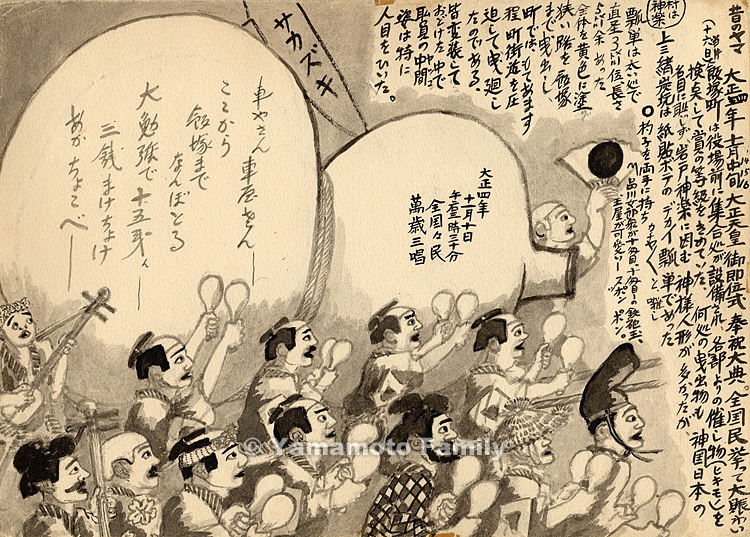
Coal Pits (Yama) in the Old Days: Grand Celebration of the Coronation of the Emperor Taisho
1958 - 1963
Mukashi no Yama: Taisho Tenno Go-sokuishiki Hoshuku Taiten
[Coal Pits (Yama) in the Old Days: Grand Celebration of the Coronation of the Emperor Taisho]
21.2 x 30.3 cm Ink Painting
In the middle of November (14th, 15th, and 16th) in 1915, the whole nation celebrated the coronation of the Emperor Taisho on a grand scale.
On December 16th, Iizuka Town set up a meeting place in front of their town hall to check the floats (hikimono) from every part of the town and rank each float.
Most floats were composed of dolls of deities made after Iwato Kagura (a type of sacred music and dance based on the myth of the sun goddess, Amaterasu Omikami), which were suitable for divine land of Japan. Though Kamimio Village sent out a float of sacred music and dance called kagura, Kamimio Coal Pit sent out a large gourd float made of paper.
The larger part of the gourd was 3 meters in diameter and was more than 5 meters long. It was entirely painted yellow, and the people in the pit pulled it out and brought it to Iizuka through a narrow pass. It was pulled around the town and bore on the crowd so imposingly that all the people in the town felt the team went a bit too far. Among all of the party fooling around in disguise, the yakko (footman: the lowest rank of samurai) costumes of the pit staff especially stood out.
Clapping rice paddles in both hands, they sang as follows:
Shinagawa joroshu ga jumomme.
Jumomme no teppo-dama.
Tama ya ga kawai. Suppompon!
Ladies in Shinagawa will treat you for ten momme.
Ten momme is the weight of a musket ball.
And Musket Ball (a cat's name) is lovely. It's stark naked (suppompon)!
[Translator's Notes: This is a traditional and comical shiritori song peculiar to Japan, in which the first word(s) of each verse except the first verse begin(s) with the last word(s) of the previous verse. The meaning of these lyrics is very ambiguous, and the above translation merely is one of the interpretations, which can be concluded.
"Momme" in the first verse represents a silver coin used in the Edo era (1603-1867). One-momme silver coin equaled 1/60 yen in the Meiji era (1868-1912).
"Momme" in the second verse represents a unit of weight in the Edo era, which equaled 3.75 grams. The "dama" of "teppo-dama" stands for "ball" and its original form is "tama". "Tama" changes to "dama" when it is placed after another word like "teppo (gun or musket)."
"Ya" after "Tama" is a particle to emphasize the word to which it is attached. "Tama" represents spherical things in general and has many meanings, such as "ball," "musket ball (bullet)," "jewel," "pearl," "bulb," "lens," "beautiful lady," "geisha," "testicle," etc. Additionally, "Tama" is the most typical name given to cats in Japan.]
Song Lyrics Written on the Larger Part of the Gourd
Kurumaya san! Kurumaya san!
Koko kara Iizuka made nambo toru?
Daibenkyo de jugosen.
Sansen maketoke, akachokobeh.
Rickshaman! Rickshaman!
What is the fare from here to Iizuka?
15 sen (0.15 yen) is the discount fare.
Discount 3 sen, or I won't use your rickshaw.
Lettering on the Gourd
The whole nation gave three cheers at 3:30 p.m. on November 10, 1915.
Lettering above the Gourd
sakazuki: sake cup
Translation Assisted by Mr. Nathan Johndro
<<Last pictorial record Next pictorial record>>
<<Last 10 items 211 | 212 | 213 | 214|215 | 216 | 217 | 218 | 219 | 220 | Next 10 Items>>
214/585