
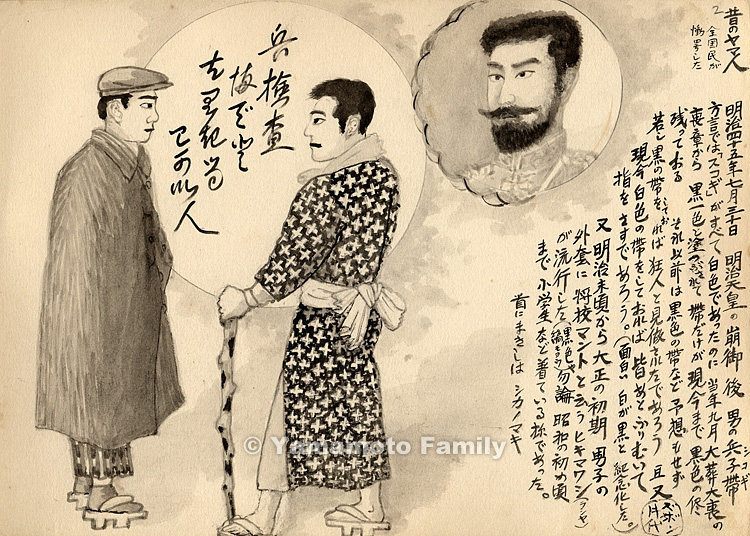
Pit Workers in the Old Days #2 (Waistbands for Men)
1958 - 1963
Mukashi no Yamabito #2 (Otoko no Hekoobi)
[Pit Workers in the Old Days #2 (Waistbands for Men)]
21.2 x 30.3 cm Ink Painting
Zen Kokumin ga Dokokushita
[The Whole Nation Wailed]
When the Emperor Meiji died on July 30, 1912, all the waistbands (hekoobi) for men which were called "shikogi" or "sukogi" in dialect were made of white cloth. However, they were all changed to black in order to offer people's condolences when the funeral service for the late emperor was held that September, and only the black color of these waistbands was still left unchanged after that.
Japanese men had not imagined wearing black waistbands before then, and if anyone had worn a black one at that time, he would have been regarded as insane. Additionally, if anyone wore a white waistband today when most men wear trousers, everyone would look back and point at him. (It is interesting that the white waistbands were changed to black ones at once as if all Japanese men had commemorated the new age.)
Likewise, the Inverness coat called a hikimawashi or shoko manto for men (made of black striped woolen cloth) became popular during the period from the end of the Meiji era (1868-1912) until the beginning of the Taisho era (1912-1926). Of course, this coat seemed to also be worn by elementary school boys until the beginning of the Showa era (1926-1989). The cloth tied around the neck of the man on the right was called a shikanomaki.
Senryu (witty and comical seventeen-syllabled poem) Written in Non-Standard Kana (a Japanese system of syllabic writing) between Two Young Men
Heikensa made to harikiru wakai hito
Young men are eager to enjoy life as freely as possible until they are conscripted
Translation Assisted by Mr. Nathan Johndro
<<Last pictorial record Next pictorial record>>
<<Last 10 items 221 | 222|223 | 224 | 225 | 226 | 227 | 228 | 229 | 230 | Next 10 Items>>
222/585