
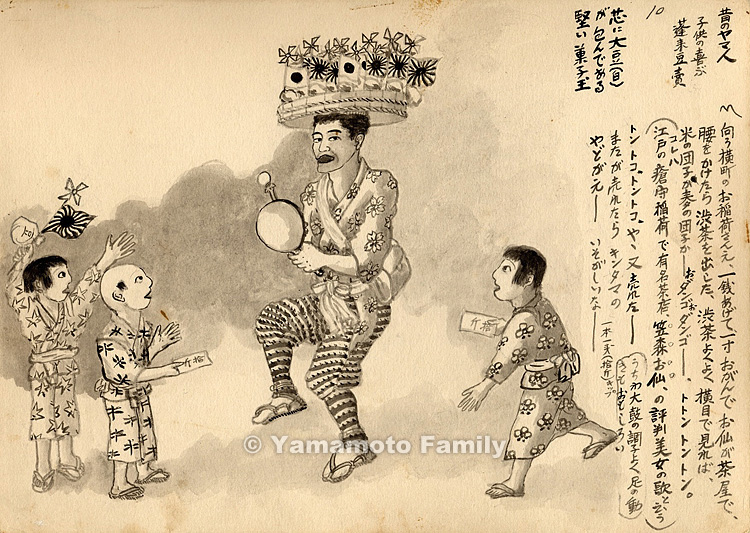
Pit Workers in the Old Days #10: Horaimame Vendor Bringing Happiness to Children
1958 - 1963
Mukashi no Yamabito #10: Kodomo no Yorokobu Horaimame-uri
[Pit Workers in the Old Days #10: Horaimame Vendor Bringing Happiness to Children]
21.2 x 30.2 cm Ink Painting
Text at the Top Right
The horaimame was a hard sugarcoated (white) soybean.
Lyrics of the Song Sung by the Vendor
Muko yokocho no Oinari san e, issen agete, chotto ogande Osen ga chaya de,
koshi o kaketara shibucha o dashita. Shibucha yoku yoku yokome de mireba,
kome no dango ka mugi no dango ka. Odango! Odango! Toton-ton-ton!
After I offered 1 sen (0.01 yen) to the Inari shrine along the opposite alley,
I prayed to Oinari san, the goddess of harvests, and went to Osen's teahouse.
As soon as I sat on the bench, they served a tray with a cup of bitter tea.
And while sipping the tea, I happened to notice rice or barley dumplings on the tray. Odango (dumpling)!
Odango! Toton-ton-ton (Onomatopoeia of the beat of the drum)!
(It was said that this song was made for a famous beautiful girl called Kasamori Osen who worked at a popular teahouse near Kasamori Inari shrine in Edo [old Tokyo].)
Lyrics of the Other Song Sung by the Vendor
Ton-toko-ton-toko! Yaya! Mata ureta.
Mata ga uretara kintama no yadogae isogashii na.
Ton-toko-ton-toko (beat of the drum)! Wow! Another bag sold.
If my thighs sold, I would be busy moving them with the buyer's body.
(He beat his fan-shaped drum rhythmically and moved his legs comically.)
(It cost us 1 sen [10 kin or 0.01 yen] to buy a bag of beans.)
[Translator's Notes: "Mata" in this song has two meanings of "another" and "thighs," and "Mata ureta" has two meanings of "Another one sold" and "My thighs sold."]
Lettering on Tokens in Two Children's Hands
jukkin: 1 sen or 0.01 yen
Lettering on the Bag of Beans in a Child's Hand
mame: beans
Translation Assisted by Mr. Nathan Johndro
<<Last pictorial record Next pictorial record>>
<<Last 10 items 241 | 242 | 243 | 244 | 245|246 | 247 | 248 | 249 | 250 | Next 10 Items>>
245/585