
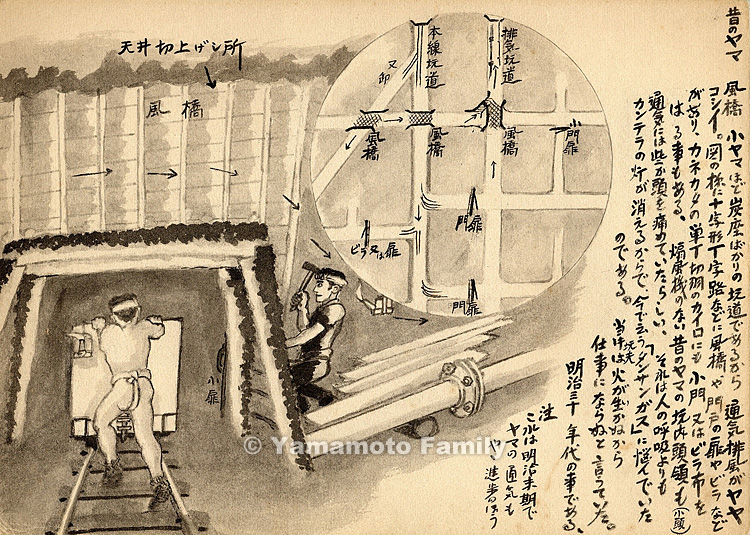
Coal Pits (Yama) in the Old Days: Air Bridge (for Ventilation)
1958 - 1963
Mukashi no Yama: Fukyo (Tsuki Haiki)
[Coal Pits (Yama) in the Old Days: Air Bridge (for Ventilation)]
21.2 x 30.3 cm Ink Painting
Small-scale coal pits (koyama) had more coalfaces and roadways than middle and large-scale ones, and the routes for ventilation were complicated in such pits. As shown in the inset, crossroads, T-junctions, etc. had air bridges, gates, or curtains. Some haulage ways (kairo: normally kaido) for single coalfaces along levels had small gates or curtains. It seemed that underground bosses at coal pits in the past, when no electric fans were available, a bit troubled about ventilation. It was not because air supply was necessary for workers but because lamp lights went out from lack of fresh air. In short, they worried about the excess of carbon dioxide which is now called "tansan gasu." Miners at that time often complained that they could not work because each of them could not light a fire in their lamp because of the gas. It was during the decade starting from 1875 to 1885.
Note: This painting shows a pit in the end of the Meiji era (1868-1912) when the ventilation system had been improved a little.
Words in the Inset
haiki kodo: return air way
fukyo: air bridge
shomompi: small door
honsen kodo: main slope
mata oroshi: diagonal slope
mompi: door
bira matawa tobira: curtain or door
Other Words in the Painting
Tenjo kiriageshi tokoro: Cut and Heightened Roof
[Translator's Notes: Each junction where the intake slope and the return air way intersected was made into a two-level crossing by building a bridge so that the return air went over it and the mixing of fresh air and return air never occurred.]
Translation Assisted by Mr. Nathan Johndro
<<Last pictorial record Next pictorial record>>
<<Last 10 items 51 | 52 | 53 | 54|55 | 56 | 57 | 58 | 59 | 60 | Next 10 Items>>
54/585