
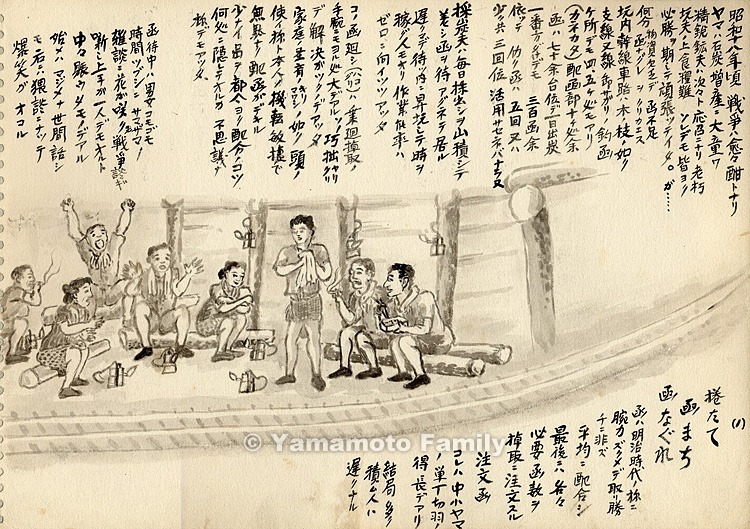
Landing #1: Waiting for Empty Mine Cars/Stasis of Mine-car Allotment
1958 - 1963
Makitate #1: Hakomachi/Hakonagure
[Landing #1: Waiting for Empty Mine Cars/Stasis of Mine-car Allotment]
21.1 x 29.8 cm Ink Painting
Text at the Bottom
It was not allowed for strong workers to forcibly take as many empty mine cars as they wanted like in the Meiji era (1868-1912), instead the mine cars were first allotted equally to each pair of miners. Finally, each pair asked the transport man to allot them the necessary numbers of additional mine cars. These additional cars were called chumon bako (ordered mine cars). This method was a characteristic of small-scale or middle-scale coal pits mining coal according to the pillar system of coal mining, and those who loaded more mine cars with more mined coal were allotted additional mine cars later than others.
Text at the Top
The war raged harder and harder around 1943 and our pit was busy increasing the production of coal. Young and strong miners were drafted into the military one after another and coal was mined mainly by old workers suffering from food shortage. In spite of such difficult conditions, all miners did their best to win the war in the end. However, the lack of goods caused a lack of mine cars, and eventually mine cars often were not smoothly allotted to miners. The railway track of the main slope reached out its branches and the branches reached out their branches like a tree. There were as many as four or five spots to moor mine cars to pillars or car stops and load them with debris (tsuribako) in the main slope. In the levels (kanekata), there were more than ten spots to which mine cars had to be sent. The pit had more than 70 mine cars and only the first shift workers produced 300 mine-car-loads of coal a day. Therefore, some mine cars were used as frequently as 5 times a day and others were at least used three times a day.
Every day, the miners in the pit would get tired of waiting for empty mine cars to be sent down to the places where they temporarily dumped and piled up the coal they mined. Some miners rose to the surface to kill time while they were waiting, and the operating efficiency fell to zero.
The efficiency of this allotment of mine cars (hakomawashi or hakoguri) depended greatly on the transport man's ability in the task. His management and skill could solve the problem of the lack of mine cars. He could efficiently allot mine cars by planning and being tactful and quick in the same way as juggling household expenses to make ends meet. There was a secret to the proper distribution of a small number of articles. His skill made me wonder where such a number of mine cars were hidden.
Men and women waiting for empty mine cars enjoyed talking about various things to kill time. Their chats began with talk about the war. If there was a good speaker, their talk went very well. Though they talked sincerely at first, they started to tell dirty jokes later and burst into laughter.
Translation Assisted by Mr. Nathan Johndro
<<Last pictorial record Next pictorial record>>
<<Last 10 items 81 | 82 | 83 | 84 | 85 | 86 | 87|88 | 89 | 90 | Next 10 Items>>
87/585