
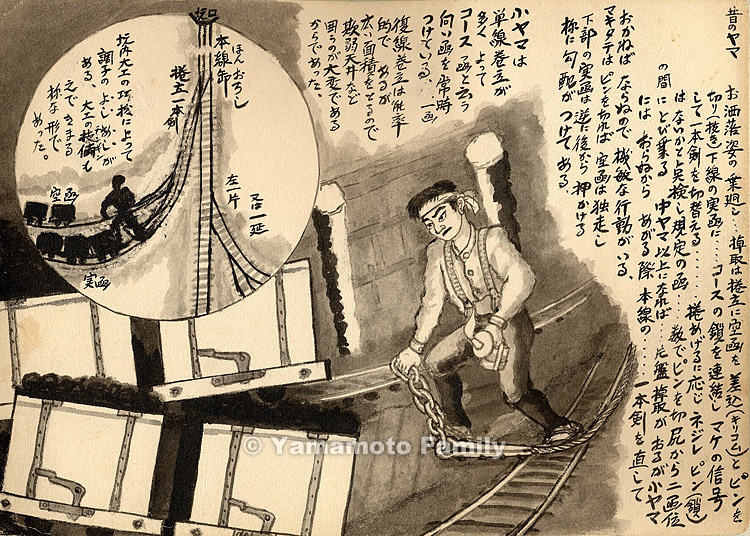
Coal Pits (Yama) in the Old Days (Transport Man's Mine Car Operation by Extracting and Inserting Connecting Pins)
1958 - 1963
Mukashi no Yama (Saodori no Pin ni yoru Sosa)
[Coal Pits (Yama) in the Old Days (Transport Man's Mine Car Operation by Extracting and Inserting Connecting Pins)]
21.2 x 30.4 cm Ink Painting
The transport man in fashionable clothes called a norimawashi, who was also called a saodori, lowered (kirikomu) empty mine cars to the landing and pulled out the pin connecting the chain of the wire rope socket to the mine cars. He connected the released chain to the head of a series of loaded mine cars on the lower track before sending a signal of "Rise!" and switched the cars from the lower track to the main track by moving a single steel bar switch called an ipponken. As the loaded mine cars rose up, he checked if the connecting chains were twisted or not. He pulled out a connecting pin to cut off the rest of the loaded cars after confirming that the specified number of mine cars passed him by. After that he jumped on connecting fittings between the second and third mine cars from the last. Middle and large-scale coal pits had a saodori at each level. However, small-scale pits did not have so many saodoris and a transport man needed to be quick to return the ipponken of the main track when he rose up with mine cars.
Levels were inclined so that empty mine cars naturally moved downward while loaded ones naturally came closer to landings on the contrary if one of their connecting pins was removed.
Though double-track landings were efficient in switching mine cars, they required large spaces. Because it was very hard to timber and support weak roofs of double-track landings, most small-scale coal pits used single-track landings. A loaded mine car (kosu bako or mukai bako) connected to the wire rope was always prepared to be coupled to and pull up other loaded mine cars.
Text and Words in the Inset
The condition of landings depended on the skill of track layers. Their skill and wages were judged and decided by the condition of landings they built.
honsen oroshi: main slope
makitate ipponken: single steel bar switch of the landing
hidari ichikata matawa ichinubi: No. 1 level left or No.1 heading
kara-bako: empty mine cars
mi-bako: loaded mine cars
Translation Assisted by Mr. Nathan Johndro
<<Last pictorial record Next pictorial record>>
<<Last 10 items 91|92 | 93 | 94 | 95 | 96 | 97 | 98 | 99 | 100 | Next 10 Items>>
91/585