
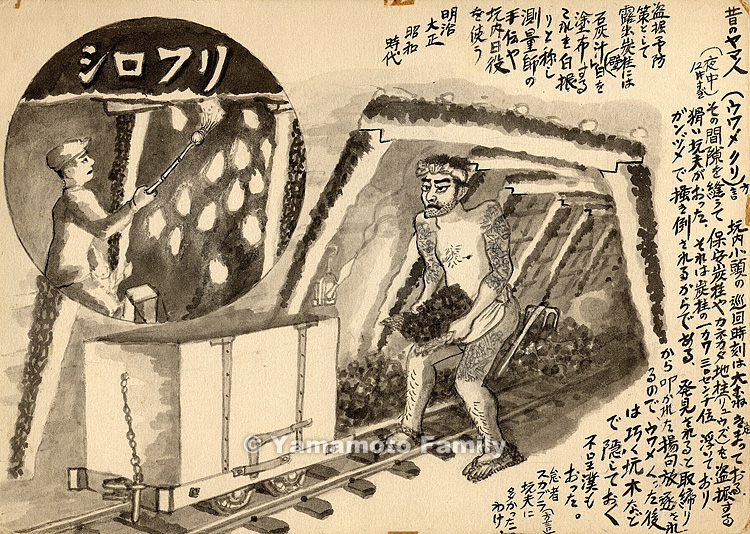
Pit Workers in the Old Days: Uwamekuri (Pit Dialect): Robbery of Coal
1958 - 1963
Mukashi no Yamabito: Uwamekuri (Hogen): Tokutsuho
[Pit Workers in the Old Days: Uwamekuri (Pit Dialect): Robbery of Coal]
21.3 x 30.4 cm Ink Painting
The underground boss generally patrolled the pit on schedule (after midnight). Some cunning miners robbed safety coal pillars or coal pillars of levels (kanekata ryuzu) of coal, catching the boss off guard. Their robberies were evident because a lot of coal pillars were found to have about a 30-centimeter gap at the bottom on each side of them. Robbers cut bottoms of coal pillars and scraped together coal with a four-bladed rake called a ganzume. Some lawless miners cunningly hid the gaps or holes which were made after they robbed coal pillars of coal (uwamekutta) with mine timbers, because they would be thrown out of the pit if their robberies were discovered. Most of them were lazy (sukabura in dialect) miners.
White limewater was applied on exposed coal pillars (or walls of coal) as a countermeasure against the above illegal mining. This measure was called shirofuri and taken by the assistant surveyor or underground day laborer in the Meiji, Taisho, and Showa eras (1868-1989).
The Word in the Inset
shirofuri: application of limewater
Translation Assisted by Mr. Nathan Johndro
<<Last pictorial record Next pictorial record>>
<<Last 10 items 121 | 122 | 123 | 124 | 125 | 126 | 127|128 | 129 | 130 | Next 10 Items>>
127/306