
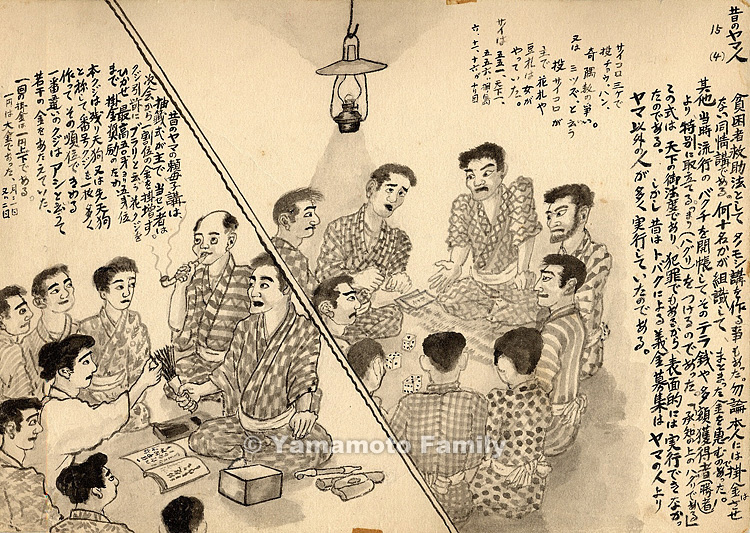
Pit Workers in the Old Days #15 (4) (Mutual Financing Association; Charity Gambling)
1958 - 1963
Mukashi no Yamabito #15 (4) (Tanomoshiko; Bokin Boshu no Bakuchi)
[Pit Workers in the Old Days #15 (4) (Mutual Financing Association; Charity Gambling)]
21.1 x 30.2 cm Ink Painting
The mutual financing association called a tanomoshiko was sometimes organized to help the poor in the coal pit. Of course, it was a sympathetic association that did not charge the poor themselves money for the premium. Dozens of people organized such organizations and gave some money to poor families. Miners also raised money by gambling, which was popular at that time, and especially collected money from the charges for the temporary gambling house or from those who got lots of winnings. In other words, the banker pushed gamblers to pay some money (haguri o tsukeru). "This haguri (collection of money) was done by mutual consent." This way of raising money could not be done openly because gambling was a taboo and crime at that time. However, people outside pits would raise more money by gambling than those inside pits.
Men mainly enjoyed three-dice games, such as Nage Cho Han played by betting on the casts of odd or even numbers made by three dice on the floor, or the dice casting game called Mitsuzu. (Card games, such as Hanafuda or Mamefuda, were played by women.) The strongest casts in Mitsuzu were Tenka-ichi of 5, 5, and 1, and Ainoshima of 5, 5, and 6. Combinations of dice which made 6, 11, and 16 in total were winning casts (narime).
In the normal tanomoshiko at the coal pit in the past, money was mainly given to the winner of a lottery and the winner paid a premium about 10 percent higher than usual from the next payment. The manager of the association let each member draw a lot called a hanakuji or burari to encourage paying premiums as much as 5 to 50 sen (0.05 to 0.5 yen) before the regular lottery. In the regular lottery, one more lot called nokori tengu or saki tengu with a number written on it was made and the winner was decided according to this number. Some money was given to each member who drew a lot called an ashi with a number bigger or smaller than the winning number by one. The premium paid at one time was about 1 yen. 1 yen was a lot of money then. They paid the premium once or twice a month.
Translation Assisted by Mr. Nathan Johndro
<<Last pictorial record Next pictorial record>>
<<Last 10 items 131 | 132 | 133 | 134 | 135 | 136 | 137 | 138 | 139 | 140| Next 10 Items>>
140/306