
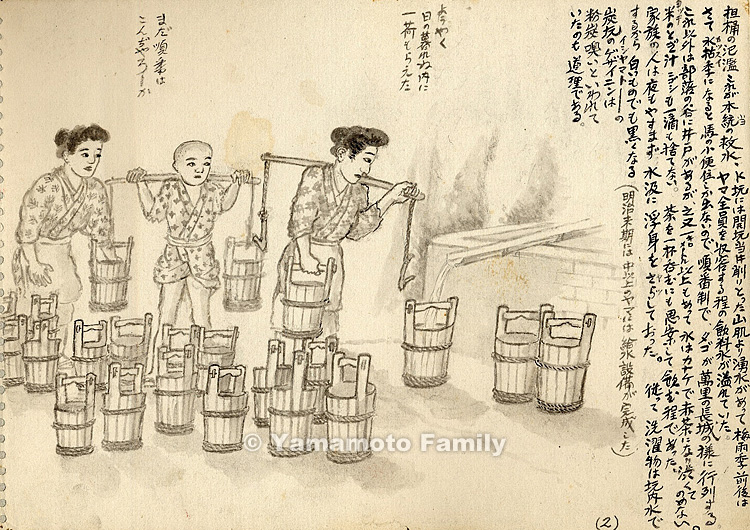
The Inundation of Shouldering Pails Carrying the Real Waters of Salvation
1958 - 1963
Tago no Hanran Kore ga Honto no Sukui Mizu
[The Inundation of Shouldering Pails Carrying the Real Waters of Salvation]
21.0 x 30.0 cm Ink Painting
K Coal Pit had a fountain springing out of the surface of the mountain which was cut away when the pit was opened. Drinking water enough for all the people in the pit filled the cistern of the fountain before and after the rainy season. However, the fountain provided only a little water, trickling like the urine of a horse, in the dry season. Many people in the pit waited for their turn to fill up and their shouldering pails were lined up like the Great Wall of China every day.
Other than this fountain, there was a well in the valley of a village 1 kilometer or more away from the pit. However, the water from the well was so rich in iron that it looked reddish brown and was too astringent to drink. Therefore, the people in the pit never wasted even a single drop of the milky water called nigoshi left after they washed rice. They were so careful in using their water that they thought twice even before drinking a cup of tea.
Pit workers' family members slaved for water without even resting at night. They washed their clothes with underground water, which turned white clothes dark.
Waterworks were completed in middle and large-scale pits in the late Meiji era (1868-1912). Therefore, it was natural to be said that gezainins [ex-convicts; pit workers humbly called themselves like this though some of them were real ex-convicts] or ishiyamatos (pit workers) smelled of dust coal.
Text at the Top Middle
"Finally, I got a pair of pails just before dark!"
Text at the Top Left
"Isn't it my turn yet?"
Translation Assisted by Mr. Nathan Johndro
<<Last pictorial record Next pictorial record>>
<<Last 10 items 141 | 142 | 143 | 144 | 145 | 146 | 147 | 148 | 149 | 150| Next 10 Items>>
150/306