
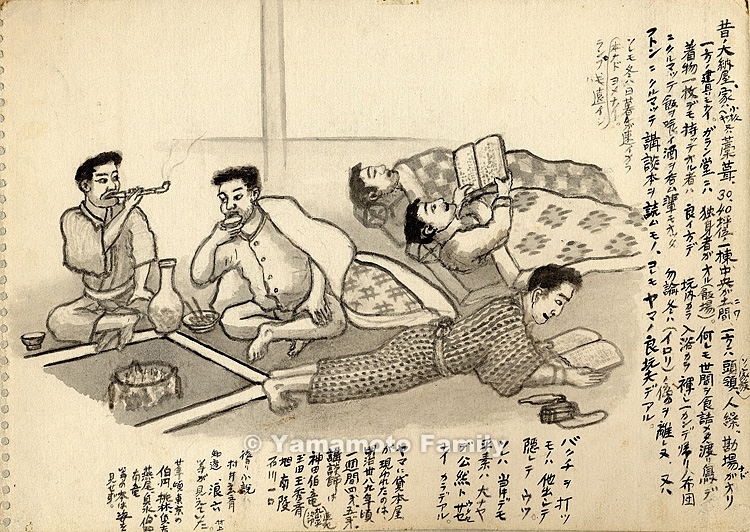
Boardinghouse for Unmarried Male Miners in the Old Days (Miners Relaxing around the Fireplace Including One Sleeping and Two Reading Books on the Floor or in Bed and Others)
1958 - 1963
Mukashi no O-naya (Iroribata, Neteiru Mono, Nekoronde Hon o Yomu Mono)
[Boardinghouse for Unmarried Male Miners in the Old Days (Miners Relaxing around the Fireplace Including One Sleeping and Two Reading Books on the Floor or in Bed and Others)]
21.0 x 30.1 cm Ink Painting
Text at the Right End
The boardinghouse called an o-naya for unmarried male miners was a big house of about 30 to 40 tsubo (99 to 132 square meters) with a shingled (hegi) or thatched roof. There was an earthen floor in the center of two rooms. In one room lived a toryo (miner group boss), his family, a hitoguri (personnel supervisor), a kamba (treasurer), and so on. In the other room, without any fixtures, lived unmarried male workers (called hambas). All of the hambas were migrants who had no place to work except coal pits. Except a few lucky ones, most of them had no coat to wear. Some of them would return to the boardinghouse from the pit after bathing, each wearing only their loincloth, and eat rice and drink sake, while slinging quilts over their shoulders. Of course, they would not leave the fireside (irori) in winter. Others, who were also good pit workers, would read story books. However, they did not have time to read books in winter because the sunset came earlier and the lamp was hung at a very high position.
Text at the Bottom
Some workers went out and gambled, hiding somewhere, because gambling publicly was usually prohibited at the o-naya even at that time.
It was around 1905 or 1906 that rental libraries appeared in coal mines. They lent a story book at 4 or 5 sen (0.04 or 0.05 yen) a week. Popular authors were Hakuryu Kanda (his story was written in shorthand by Heijiro Maruyama), Gyokushusai Tamada, Nanryo Asahi, and Ikko Ishikawa. Later, novels by Gensai Murai, Chiyu, Namiroku, Murai and so on were lent by these libraries. Story books narrated by storytellers in Tokyo around 1887, such as Hakuen, Torin, Teikichi, Embi, Teisui, Hakuchi, Nanryu and so on were not available.
Translation Assisted by Mr. Nathan Johndro
<<Last pictorial record Next pictorial record>>
<<Last 10 items 161|162 | 163 | 164 | 165 | 166 | 167 | 168 | 169 | 170 | Next 10 Items>>
161/306