
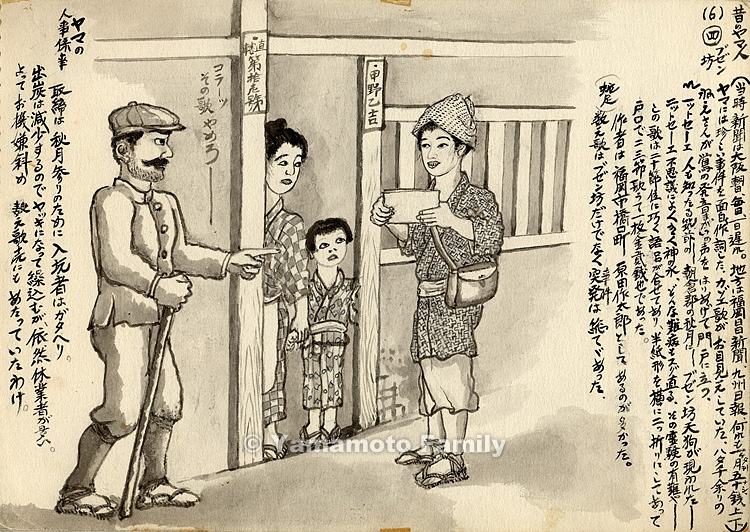
Pit Workers in the Old Days #6: Buzen-bo #4 (Counting Song)
1958 - 1963
Mukashi no Yamabito #6: Buzen-bo #4 (Kazoe Uta)
[Pit Workers in the Old Days #6: Buzen-bo #4 (Counting Song)]
20.9 x 29.9 cm Ink Painting
(National newspapers at that time, such as the Osaka Asahi and Osaka Mainichi, were delivered on a next-day-delivery basis. Our local newspapers were the Fukuoka Nichinichi Shimbun and Kyushu Nippo. All of them cost about 50 sen a copy and had no evening edition.)
Once, a counting song was introduced to the pit, whose lyrics mentioned the events about which the people in the pit rarely heard. A young woman more than 20 years of age stood in front of each house, singing loudly in a beautiful voice like a Japanese bush warbler which started to sing first every spring as follows:
Lyrics of the Counting Song
Hitotsu to seeh! Hito mo shittaru Chikuzen no Asakura-gun no Akizuki ni,
Buzen-bo tengu ga arawareta.
Futatsu to seeh! Fushigini yoku kiku kami no mizu don-na nambyo mo sugu nayoru (sic: naoru in normal Japanese). Sono reigen no arigata ya.
Firstly! Buzen-bo tengu (Japanese long-nosed goblin) appeared in Akizuki in Asakura County in Chikuzen as you know well.
Secondly! The water of this deity has marvelous effects on any serious diseases and cures them immediately. How nice the miraculous effects of the water are!
The lyrics of this song were composed of about twenty verses which were skillfully punned and were printed on a piece of Japanese calligraphy paper folded widthwise. She sold each piece of paper at 2 sen (0.02 yen) after singing two or three verses of the song. It was written on most pieces of such paper that the writer of the song was Sakujiro Harada who lived in Hashiguchimachi in Nakashima, Fukuoka City.
(Additional Notes: The counting song mentioned not only Buzen-bo but also mentioned all emergencies at that time.)
By visiting Akizuki, miners entering the pit greatly decreased in number and it became difficult for the pit to meet the expected output of coal, the personnel boss in the pit (torishimari) tried hard to spur miners to enter the pit. However, a lot of miners still took days off. Therefore, he was in a bad humor and hard on the counting song sales woman.
The Personnel Boss 's Words
"Korah! Sono uta yamero!"
"Hey! Stop singing that song!"
Lettering on the Plates on the Pillars on Both Sides of the Doorway
Kono [family name] Otsukichi [given name]
chokkatsu: Miners under the Direct Control of the Company
dai ju ichigo: No. 11
Translation Assisted by Mr. Nathan Johndro
<<Last pictorial record Next pictorial record>>
<<Last 10 items 181 | 182 | 183|184 | 185 | 186 | 187 | 188 | 189 | 190 | Next 10 Items>>
183/306