
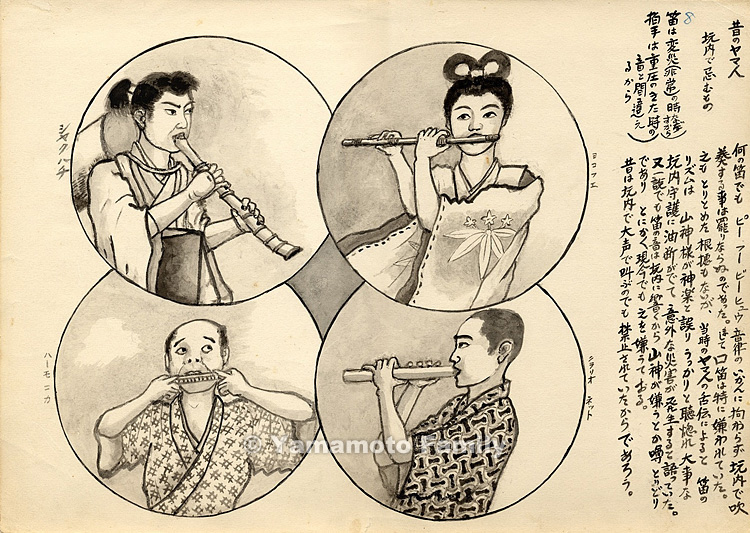
Pit Workers in the Old Days #8: Taboos in the Pit (Playing Wind Instruments)
1958 - 1963
Mukashi no Yamabito #8: Konai de Imu Mono (Fue)
[Pit Workers in the Old Days #8: Taboos in the Pit (Playing Wind Instruments)]
25.6 x 35.6 cm Ink Painting
Text at the Bottom Right
Pit workers (yamabito) could not play any wind instruments underground whatever it was regardless of the melody. Moreover, whistling was especially hated by them. There was no good reason why they could not do so underground. However, according to a tradition among the pit workers at that time, the guardian deity of the pit would confuse the rhythm of whistling with a kagura (sacred music and dance), listen to it distractedly, and become off guard against the protection of the pit, causing unexpected disasters. Another tradition says that the deity of the pit hates whistling sounds because they reverberate through the pit. There were a lot of rumors about this taboo. In any case, the pit workers hate fluting or whistling underground even today. I suppose it is because shouting loudly underground was also prohibited in the past.
Text at the Top Right
Piping and whistling was tabooed because pipes or whistles were blown when disasters happened.
Clapping hands was tabooed because it was confused with the cracking sound made by wedges or pillars breaking from increased rock pressure.
Lettering beside the Insets
yokobue: flute
kurarionetto: clarionet [instrument other than the clarinet]
shakuhachi: Japanese bamboo flute
hamonika: harmonica
Translation Assisted by Mr. Nathan Johndro
<<Last pictorial record Next pictorial record>>
<<Last 10 items 181 | 182 | 183 | 184 | 185 | 186 | 187 | 188 | 189|190 | Next 10 Items>>
189/306