
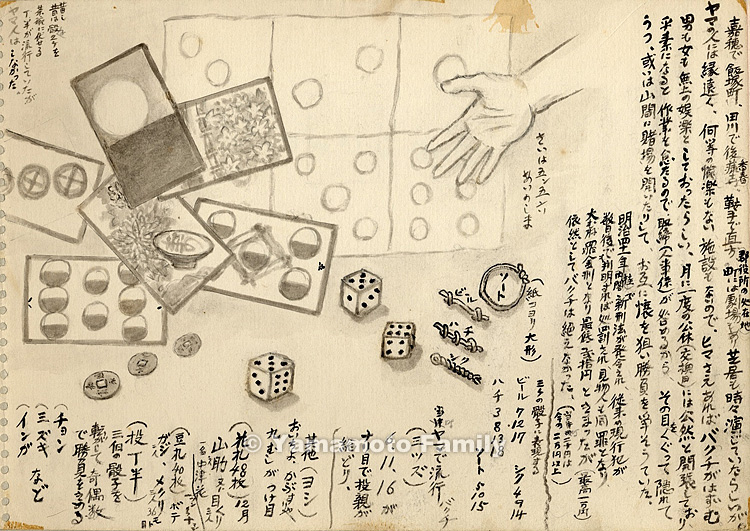
Amusements: Various Gambling Games
1958 - 1963
Te-asobi: Bakuchi no Iroiro
[Amusements: Various Gambling Games]
21.0 x 30.0 cm Ink Painting
It seems that plays were sometimes performed at theaters in the towns where each district office was located, such as Iizuka Town in Kaho County, Gotoji Town and Kawara Town in Tagawa County, and Nogata Town in Kurate County. However, since miners were strangers to the theaters and no pit had amusement facilities, they always played gambling games for their leisure. Gambling seems to have been the greatest amusement for both men and women. They publicly gambled on holidays (kokan-bi: exchange day) given once a month. Since personnel bosses strictly watched over miners to prevent them from being idle on workdays, they secretly gambled while hiding somewhere. They sometimes gambled in the mountains and tried to win money from each other.
In 1908, the Katsura Cabinet brought the new criminal law into force, and the police became able to arrest and punish both gamblers and persons in their company not only caught in the act but also after a few days. Gamblers were generally fined at least 20 yen (10,000 yen at the maximum). However, gambling among miners still never ceased. (20 yen at that time equals more than 20,000 yen today.)
(Chips of Large-sized Paper String)
[Translator's Notes: Each number written below probably represents the total of numbers composing a combination made by three thrown dice.]
Biiru: 7, 12, or 17
Shiku: 4, 9, or 14
Hachi: 3, 8, 13, or 18
Soto: 5, 10, or 15
This was a gambling game using dice called Mitsuzu, which was popular in pits at that time. Totals of numbers composing combinations of three dice i.e. 6, 11, and 16 were the winning casts, and the caster took all of the stakes.
(Hanafuda Games Using 48 Playing Cards)
Each suit represents 12 months.
There were games, such as Yamasuke played by two people or Mekuri also called Nakatsubana played by three people.
Another Hanafuda Card Game (Yoshi)
When they play Yoshi or Oicho-Kabu, it was best to aim for a winning combination called kumushi.
[Translator's Notes: In Oicho-Kabu (Eight-Nine), each player tries to make a combination of cards representing a number as large as 9 or 19. If no player can make 9 or 19, the one who make the next largest number is the winner. Therefore, a combination representing 8 is very advantageous. Kumushi probably means the winning combination of cards representing 9 (ku), 6(mu), and 4(shi).]
(Games Using 40 Mamefuda Playing Cards)
Each suit in mamefuda was composed of cards representing from one (ittsun) to ten (ju). There were mamefuda games, such as Bote or Gaji played by two people, and Mekuri or Motome played by three people with 36 cards.
(Nage Chohan Dice Game)
Miners bet on even or odd numbers of the casts made by three dice. Some of the names of winning combinations were Chon, Mizuki, Inga, etc.
Text at the Top Left
It was said that a Chohan dice game, in which two dice were thrown into a teacup and the teacup was inverted on the floor, was once popular. However, miners never played this game.
Text beneath the Figure of a Hand
Sai wa gon go roku Ainoshima
My six and double fives made a winning combination called Ainoshima!
Translation Assisted by Mr. Nathan Johndro
<<Last pictorial record Next pictorial record>>
<<Last 10 items 211|212 | 213 | 214 | 215 | 216 | 217 | 218 | 219 | 220 | Next 10 Items>>
211/306