
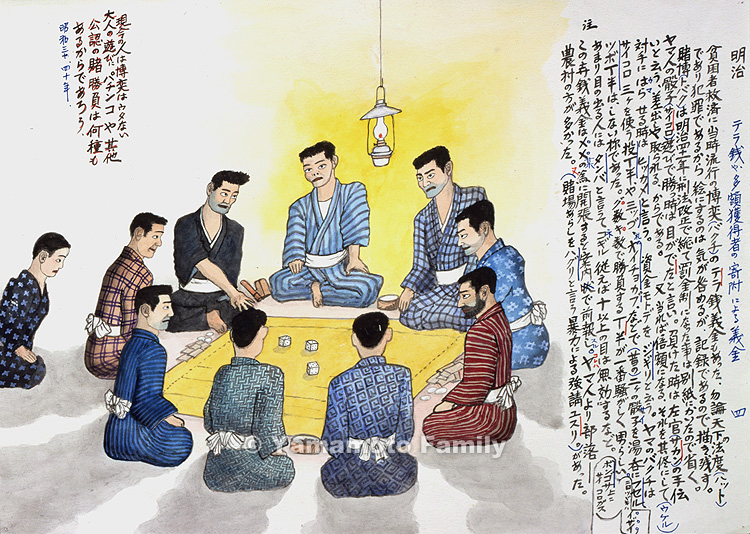
Donations by Gambling Banks and/or Donations by Gamblers with Big Winnings in the Meiji Era (1868-1912) #4
September 1965
Meiji Terasen ya Tagaku Kakutokusha no Kifu ni yoru Gikin #4
[Donations by Gambling Banks and Donations by Gamblers with Big Winnings in the Meiji Era (1868-1912) #4]
38.1 x 53.9 cm Painting in Watercolors and Ink
Donations called terasen gikins by gambling banks were used in order to help some poor families in various communities. Of course, gambling is a crime and I feel guilty drawing a painting of gambling. However, I would like to paint and leave it as a record to be remembered. I do not go into details of the fact that all gambling was banned by the criminal law revised in 1908 and has been fined since then, because I described it in another painting.
Miners called a win in dice games "me ga deta (the dice made a winning cast)" while they called a loss "sakan no tetsudai (help with a plasterer's work)," because they had to lose their stakes when they lost. If you won, your winnings would be twice as much as your stakes. If you bet all of the winning (ukeru) and made your opponent bet on the next cast of dice (haraseru or kamaseru), this play was called hikkame. One's cash for betting was called jigiri.
Gambling games popular at coal pits were Nage Cho-han or Mitsuzu using three dice, a card game called Oichokabu using hanafuda cards, and so on. They did not seem to play Tsubo Cho-han (a Cho-han dice game) in old times played with a pair of dice and a Japanese tea cup to shake the dice inside and upturn onto the floor. I think the most exciting, noisiest, and manliest games were Cho-han dice games where you bet on odd or even numbers of the throw. (The same cast made twice in a row was called izai.) Those who often won were handicapped (negiru or kogiru) by a call of "Tamba." If they accepted the call, casts of more than 10 points were sometimes nullified. (When they played dice games, they cast the dice on a straw mat.)
Creator's Notes: Whenever a gambling game took place as a terasen gikin, the gambling bank always notified people of the purpose for whom it was planned in writing beforehand. This kind of donation was made for the people living in farm villages or other villages around coal pits rather than for the people living in the pits. Robberies at gambling places were called haguri. Sometimes there was extortion with violence.
Today (1950s and 60s) I do not see people gamble as I described above, and I guess it is because we have some legalized gambling games like pachinko (Japanese-style pin-ball) as amusements for adults.
Translation Assisted by Mr. Nathan Johndro
<<Last pictorial record Next pictorial record>>
<<Last 10 items 21 | 22 | 23|24 | 25 | 26 | 27 | 28 | 29 | 30 | Next 10 Items>>
23/33